OpenAI's GPT-5.4-Cyber is not just another model release.
It is a signal that cyber-capable AI is moving into a new governance class.
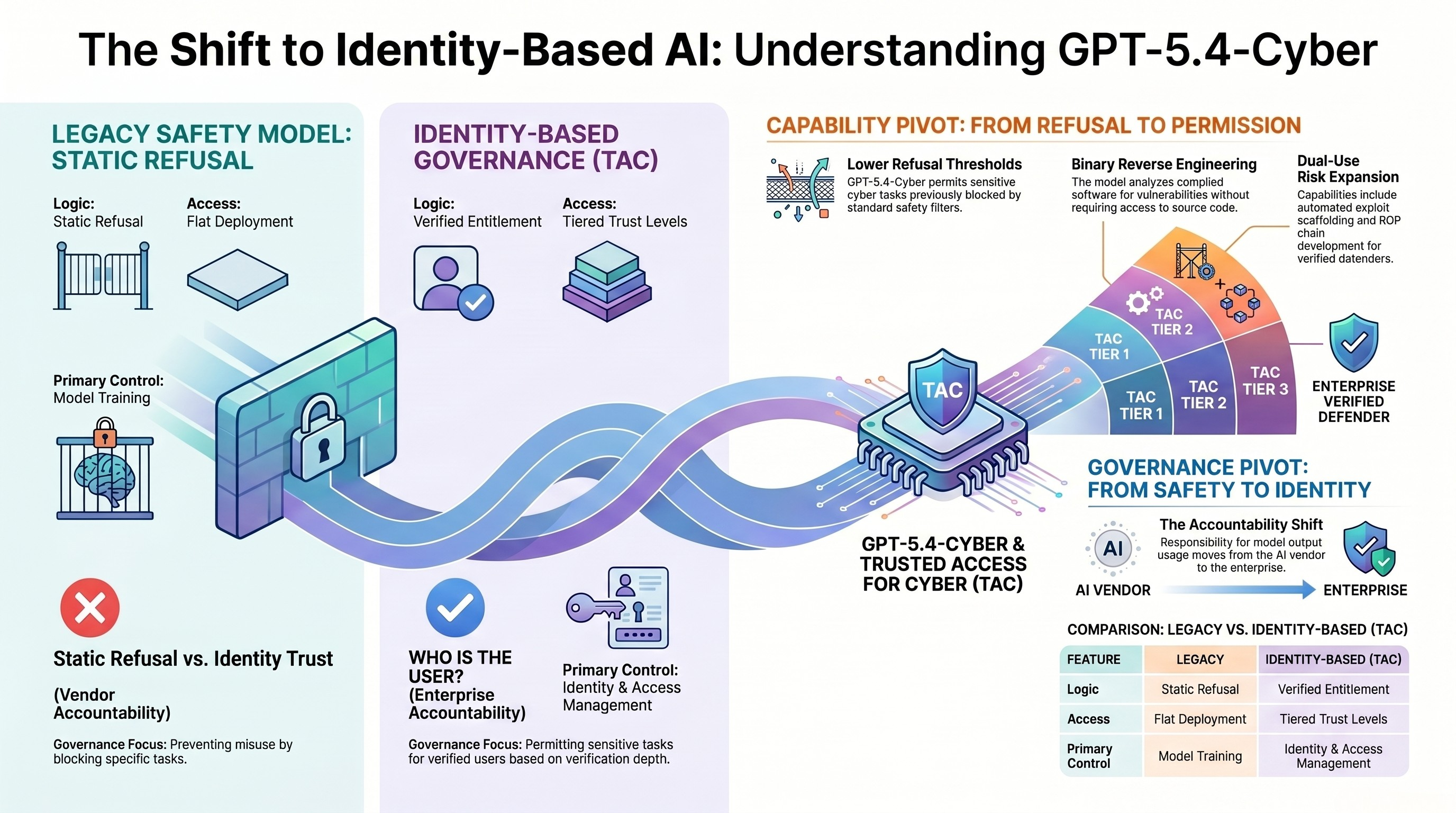
The key development is not simply that OpenAI fine-tuned a model to be more useful for defensive cyber work. The bigger story is that access to those more permissive cyber behaviors is being gated through a trusted-access structure rather than exposed as a standard public capability.
That matters because it changes the enterprise conversation. The question is no longer just whether a model can support reverse engineering, triage, or exploit analysis. The question is who gets access, under what identity controls, with what monitoring, and under which policy boundaries.
A cyber-capable model now becomes an enterprise governance problem the moment its risk is managed through entitlement, verification, and oversight instead of static refusal logic alone.
Security leaders should pay attention to what this implies for their own architecture. If frontier vendors are segmenting high-risk AI capability behind trust tiers, enterprises will need their own internal AI control plane to do the same — policy enforcement, role-based access, activity logging, and exception governance included.
This is not a chatbot maturity story.
It is the beginning of privileged AI operations.
♾ The AI Threat Brief | AI Security Intelligence for Leaders